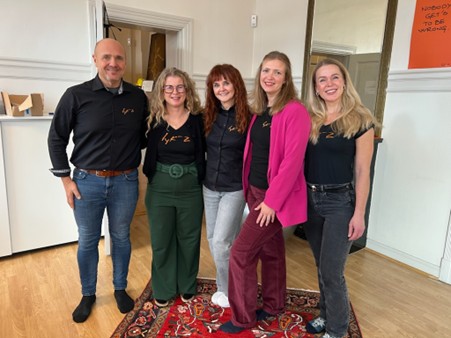
Interview with Vera Lykseth from Lyk-z & døtre
This June, the JobAut project Consortium is organising a specialised training week in Skien, Norway. Hosted at the office of Lyk-z & døtre, this event will bring together European project partners, job coaches and professionals involved in the coaching and social inclusion of autistic people. The programme includes over 30 hours of activities covering the JobAut methodology, materials, and facilitation strategies.
Participants will leave with increased knowledge and skills around supporting autistic people in the workplace, hands-on competence in applying the JobAut methodology and toolkit, and familiarity with ICF standards and how they apply in practice.
To mark the occasion, we talked with Vera Lykseth from Lyk-z & døtre about her work, coaching philosophy, and what participants can expect from the training.
Lyk-z & døtre as is a social enterprise based in Skien, Norway, committed to empowering people to create sustainable change in their lives. Their coaching programmes are based on the FROG Methodology: communication techniques that can help people discover their talents, build their self-confidence and define a life project aligned with their values, goals, and ambitions.
For the past year, the JobAut consortium has been working to adapt this methodology to meet the needs of autistic people and enhance the skills of job coaches and employment professional supporting them.
Could you introduce yourself and tell us about your role at lyk-z & døtre as?
My name is Vera Lykseth. I am a senior professional co-active coach, a certified FROG instructor, and a registered nurse. I have been part of the lyk-z & døtre for 13 years. In my role, I co-lead leadership programmes that last from 5 to 35 days with different target groups, mainly young people at risk. I also train new FROG instructors who work in schools, employment services, and career centres. On top of this, I offer one-to-one coaching and contribute to EU-funded projects.
Could you describe what it means to be a FROG instructor, and what makes this approach distinctive?
As a FROG instructor, my work is based on the belief that every participant has the ability to change and grow. I don’t guide the room, give advice or tell people what to do. Instead, my role is to ask the right questions that open new reflections and help people find their own answers and insights. I am a catalyst. I have a methodology and a set of tools I use to facilitate and support groups. I believe the growth, the answers, and the connections are already inside each participant, my role is to bring them out. To do this well, I need to stay open-minded, flexible, and I am always seeking for change and movement. I focus on the present and the future and on each person’s strengths, desires, and values.
The way we see, meet, and include our participants and trust their ability to change, is part of what makes the FROG instructor distinctive.
Do you have experience coaching autistic people? What do you do to create an environment where everyone feels comfortable and included?
In the past 13 years, I have probably worked on around 50 programmes, with an estimated 1 or 2 autistic participants in most groups. Our activities always take place in a calm and comfortable environment, in open spaces, with light walls, few colours, tidiness and order.
I usually prefer to know as little as possible about the participants beforehand and base everything on the meeting with the person. Some participants mention that they are autistic during or after the programme, other show similar characteristics to autistic people, or say it when they are challenged.
Our methodology is designed to make everyone feel seen, heard and included. We treat each participant with trust, respect, and dignity. We believe each participant has a big potential – bigger than what they – or society think they have, and we create the conditions where that potential can grow.
We invite and train participants to express their needs and wishes for the environment. When adaptations are needed, we can include a longer processing time, a mix of open and closed questions, a quiet space to rest, more information about the day’s agenda in advance, or small adjustments to certain tools.
Could you please describe what the training week will look like, and what do you hope participants will take away from this experience?
This 30–35-hour training includes the full 15-hour JobAut programme that coaches will later deliver themselves, allowing them to experience it before facilitating it. The training builds both practical skills and confidence. Coaches learn the tools, structure, and guiding principles of the methodology, including the concept of the “invisible line”: maintaining respectful boundaries while letting participants lead their own process. Coaches are always trained in pairs, practising co-leadership and how to support group dynamics with presence and clarity. This approach is rooted in co-active coaching and the FROG methodology and is built on trust, autonomy, and sustainable change.
Could you please describe the future training for autistic people?
The programme is 15 hours in total, split into seven sessions of two hours each, with a final session of three hours. Sessions can be conducted daily or spread over two weeks, depending on what works best. Each session is led by two job coaches working together. Participants sit in a semicircle facing the co-leaders.
The programme is built around four modules: vision, identity, communication, and impact, with communication running through all of them. Through a mix of individual, paired, and group exercises, the participants explore their personal vision, strengths, values, and driving forces. They work with images, emotional expression, and language, and practice self-awareness and conscious choice. Tools for broadening perspectives help build empathy and reduce misunderstandings.
Every session follows a similar structure: tools are introduced and demonstrated, participants work with them, and each step ends with a group debrief where co-leaders ask deepening questions. Daily home assignments help participants practise what they’ve learned in their own lives.
By the end of the programme, every participant has created their own personal, value-based plan for their future job transition. The tools are acknowledged, playful, challenging, and varied.
What are you most excited for the training week with our partners?
We are very excited to see how the 5 days are grasped and understood by the job coaches and partners and whether they resonate with and meet the expectations of each participant. We hope everyone leaves feeling satisfied and empowered in their professional role, as a partner in the JobAut project and in their personal lives too.
After the day training from 9am to 4pm, we will have social gatherings and meetups in the afternoon. We are thrilled to show our partners our city and the nature it has to offer. There is something magical about gathering people from different cultures and countries in the same place around the same vision and hope. Co-creating resources with different expertise, knowledge, perspectives and professions is both challenging and enriching, and it is exactly this kind of diversity that leads to new solutions.