
Assessment frameworks and tools
4.1 Conceptual basis: from diagnosis to functioning
The assessment process is based on a functional perspective that prioritises abilities, strategies, and contextual interaction over diagnostic labels.
This shift aligns with international standards and ensures that the analysis remains relevant to real-life employment situations.
4.2 Integrating the ICF in placement feasibility
During the interview, the ICF framework is used conceptually to guide data collection.
Observations are organised around domains such as body functions, activities and participation, and environmental factors, ensuring that the information gathered is comprehensive and structured.
4.3 The JobAut Assessment Grid
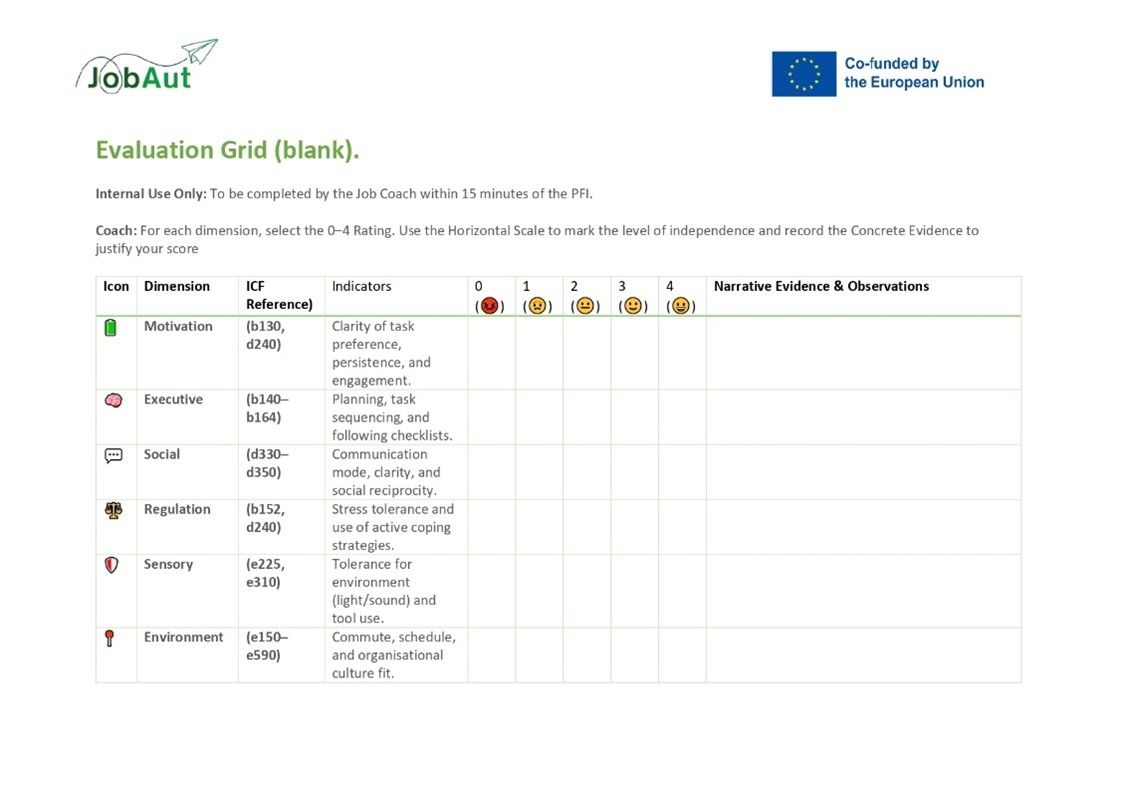
The Assessment Grid is used to organise and synthesise the information collected during the interview.
It provides a structured format that supports consistency and facilitates the transition to the next phase.
4.4 Observation & Behavioural Notes (Evidence Log)
The Evidence Log allows the job coach to document observed behaviours and contextual conditions in a systematic way.
This tool ensures that qualitative data is captured accurately and can later be translated into a structured profile.
4.5 Visual mapping of feasibility outcomes
The methodology includes visual tools that support the representation of findings, making them more accessible and easier to interpret.
4.6 Interpreting results and ensuring validity
The interpretation of results requires careful consideration of both qualitative and contextual factors.
The job coach must ensure that conclusions are grounded in evidence and reflect the complexity of the individual’s functioning.
4.7 Visual process overview: the JobAut operational journey
The methodology follows a coherent process that connects all phases in a continuous pathway, often referred to as the “golden thread”.

